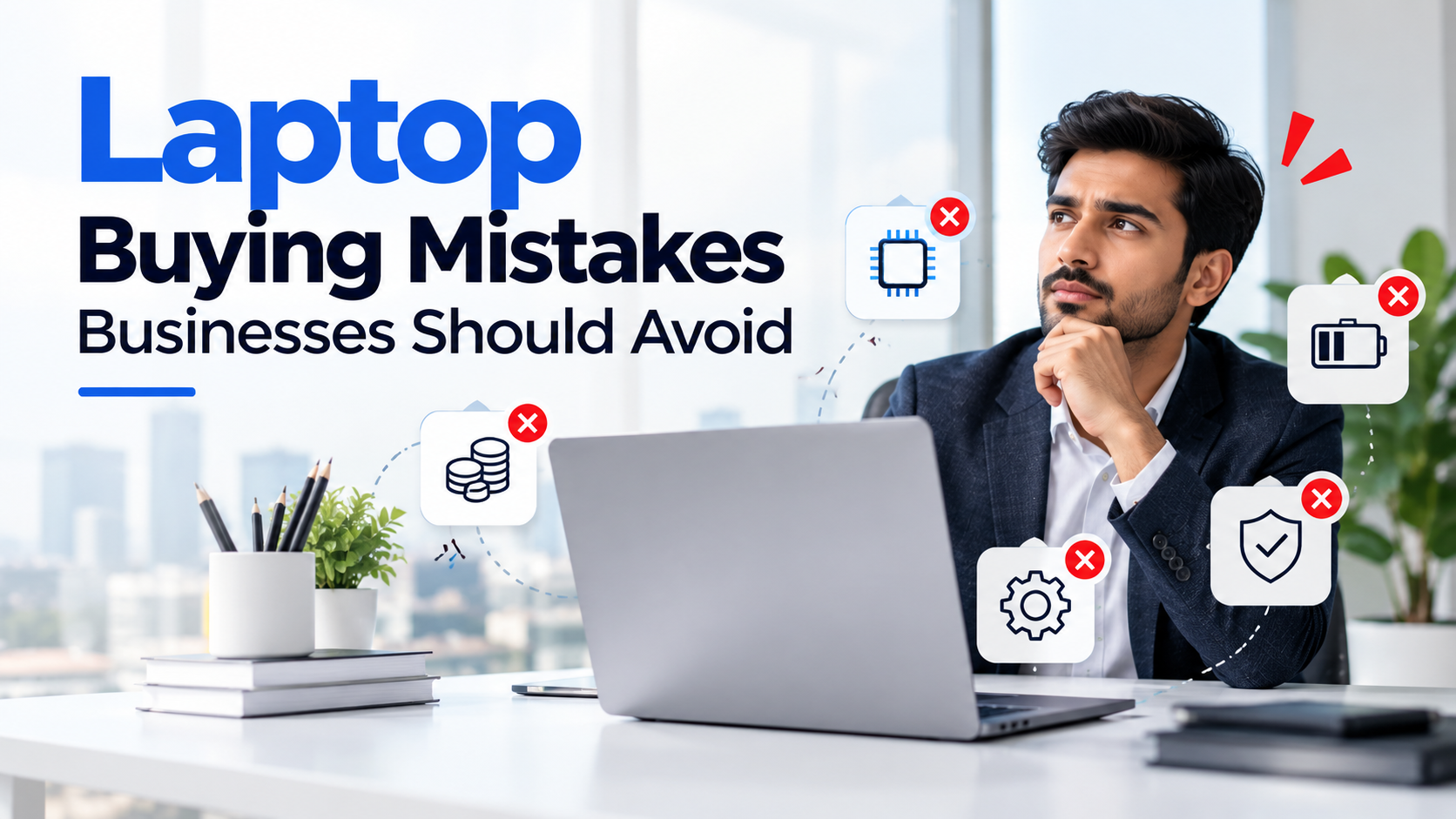
Common Mistakes Businesses Make When Buying Laptops
Laptops for a business are bought quite differently from the way a personal device is bought. A company often requires laptops for multiple teams, various locations, new recruits, short-term projects, or large deployments.
When several devices are being purchased, a small error in the purchasing process can result in a bigger loss. Knowing the most common mistakes in advance can assist buyers in making more informed decisions.
1. Choosing Only Based on Price
Price is typically a critical influence when it comes to a company's purchasing decisions, but opting for the least expensive type of laptop may lead to issues down the road.
A cheaper option could lead to insufficient performance for the tasks and software involved in the everyday work of employees. Slow machines may also create productivity problems and necessitate additional upgrades or replacements.
Rather than comparing prices alone, companies should think about whether the laptop's configuration ensures appropriate performance and reliability to meet its intended purpose.
2. Using One Configuration for Every Employee
Not all employees do the same work.
The team responsible for managing emails, documents, and video meetings might have different needs than developers, designers, engineers, or employees using specialized programs.
Using the same configuration for everyone may lead businesses to procure specifications that will not be needed by some employees, while others may have to use machines that are under-optimized for their work.
It is better to choose configurations according to the requirements of each role.
3. Getting Distracted by Specifications
Compared to lower-specified devices, laptops with higher RAM, a newer processor, or increased storage space may look better on paper. However, higher specifications do not necessarily make a laptop the most suitable option.
Companies need to consider the complete laptop configuration and its effectiveness against the workload.
The right question to ask is whether the laptop is able to perform the required work.
This approach is much better than simply comparing specification figures.
4. Ignoring How Long the Laptops Will Be Needed
Assuming that all laptop needs are permanent is one of the major errors.
Take a business that is beginning a six-month project or a business that is setting up a three-month training program . It may need a large number of laptops, but only for a specific period.
If the business buys all these laptops, it may be left with equipment that is no longer required once the project or training program ends. In such situations, bulk laptop rental can also be considered.
5. Underestimating Large-Quantity Requirements
When a requirement moves from a couple of laptops to many laptops, the process changes significantly.
Large-scale deployments may include custom configurations, several users, logistics coordination, and strict project timelines.
Businesses should not wait until the last minute to start the implementation process.
A business needs to define the quantity and configuration early enough, especially when laptops are required for an event, project kickoff, or special training program.
6. Assuming Buying Is Always the Only Option
Businesses often associate laptop requirements directly with purchasing. However, the right approach depends on the actual situation.
Permanent employees may require long-term systems, while temporary projects or large short-term deployments may call for a different solution.
Rental can be considered when businesses need laptops for a specific period without committing to permanent ownership.
Make the Decision Around the Business Requirement
There is no single laptop or purchasing approach that works for every business.
The better starting point is to understand the workload, required configuration, number of laptops, and expected usage period. These factors make it easier to decide whether purchasing or renting is the right fit.
For businesses requiring laptops for projects , training programs, events, temporary teams, or large deployments, Laptops India provides bulk laptop rental solutions based on the required specifications and rental duration.
Before placing a large laptop order, take a step back and look at the actual requirement. Avoiding the wrong purchase can be just as valuable as finding the right one.
FAQs
1. What is a common mistake businesses make when buying laptops?
Choosing laptops based only on price can result in poor performance or higher costs over time.
2. Should every employee receive the same laptop configuration?
No. Laptop configurations should match the workload and software requirements of different employees and teams.
3. Is buying laptops always suitable for temporary projects?
Not necessarily. For short-term projects, training programs, or temporary teams, bulk laptop rental can be an alternative.
4. Why is planning important for large laptop requirements?
Large deployments require coordination around quantity, configuration, availability, and delivery timelines.
5. When should businesses consider laptop rental?
Laptop rental can be considered when devices are required temporarily or in large quantities for a defined period.




No comments yet. Be the first to comment.